Why some passing moves have exactly one solution
By Marco Pereira · Jun 10, 2026
Follow one complete TikiTaka board, then see why a legal opening pass can still lead to a dead end.
Updated 2026-09-21
TikiTaka asks you to start at the deepest player, visit every teammate once and finish at the goal. Straight passes must clear defender pressing zones and other players. When the board uses the no-crossing rule, a later pass must also avoid every earlier pass line.
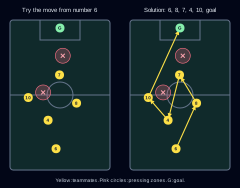
The practice board below was generated with MatchIQ’s own puzzle generator. It is a standalone teaching example, not today’s daily. We checked the pictured move against the game’s pass rules and enumerated the complete moves with crossing forbidden: exactly one solution remains.
Read the board before revealing the move
Number 6 starts with the ball near the bottom. The other shirts are 4, 8, 7 and 10. Pink circles show the defenders’ pressing zones; G is the goal. The right panel gives the answer, so cover it if you want to reason through the left panel first.
The complete order is 6, 8, 7, 4, 10, goal. Notice the backward pass from 7 to 4. Progress toward the goal is not a rule: using every teammate and keeping the remaining lanes open is what matters.
Step 1: four legal openings, only one complete move
From 6, all four teammates can receive a legal first pass. The board does not tell you which of those choices will eventually succeed. Choose 8, on the right. Starting with 4, 7 or 10 leaves no complete solution under these rules, even though the first pass itself is allowed.
This distinction is useful throughout TikiTaka: an open lane is a local fact. A route that reaches every teammate and the goal is a property of the whole move. Before passing, look at which player will become difficult to reach afterwards.
Step 2: use 8 to reach 7
From 8, the passes to 7 and 4 are both legal. The direct pass to 10 is intercepted by the defender zone on the left. Continue to 7. Choosing 4 here is another legal move that cannot be extended into a complete solution.
The right-side route has now used 6 and 8 without cutting off the remaining pair on the left. A line that appears to point toward a teammate still needs to clear the whole pressing circle, not just the defender’s centre.
Steps 3 to 5: go back, go left, then shoot
At 7, the defender blocks the direct pass to 10. Pass back down the pitch to 4, then out to 10. All five teammates have now touched the ball, so 10 can shoot at G through the clear lane to the left of the upper defender.
Trying to shoot earlier is rejected because a teammate has not yet received. Passing through another player is also blocked, even if that player has already touched the ball. On this board, no pass or shot in the final move crosses an earlier line.
What the single-solution check proves
With 6 fixed as the starting player and four other teammates, there are 4 × 3 × 2 × 1 = 24 possible teammate orders before applying the passing restrictions. Only one reaches the goal legally on this board. This count includes all complete orders, rather than only checking that the illustrated answer works.
Adding players does not by itself guarantee one solution. Their positions, screening, defender zones and crossing rules determine how many moves survive. Our example shows why working backwards from a possible finish and watching for stranded teammates is more useful than always choosing the nearest pass.
For your next board, identify a possible finisher, find the awkward teammate with few exits, and plan how to connect them before committing. Use the previous receiver to undo a pass when you need to retrace the move.
Key takeaways
- A legal first pass can still lead to a dead end.
- Backward passes can preserve the only complete route.
- Avoid whole defender zones and screening teammates.
- Treat the goal as the final step after every teammate has received.
More football guides
- The Bosman ruling and transfer fees
- How football transfer fees actually work
- What makes a footballer expensive
- How to identify a football stadium from a single view
- Ten football stadiums worth knowing on sight
- A working timeline of modern football
- Six rule changes that reshaped football
- Passing triangles and the logic of positional play
- How to get better at football quizzes
- How top-ten lists work in football
- What makes a good football trivia question