Passing triangles and the logic of positional play
By Marco Pereira · Jul 1, 2026
Possession football is a geometry problem: always have two options, and never block your own next pass.
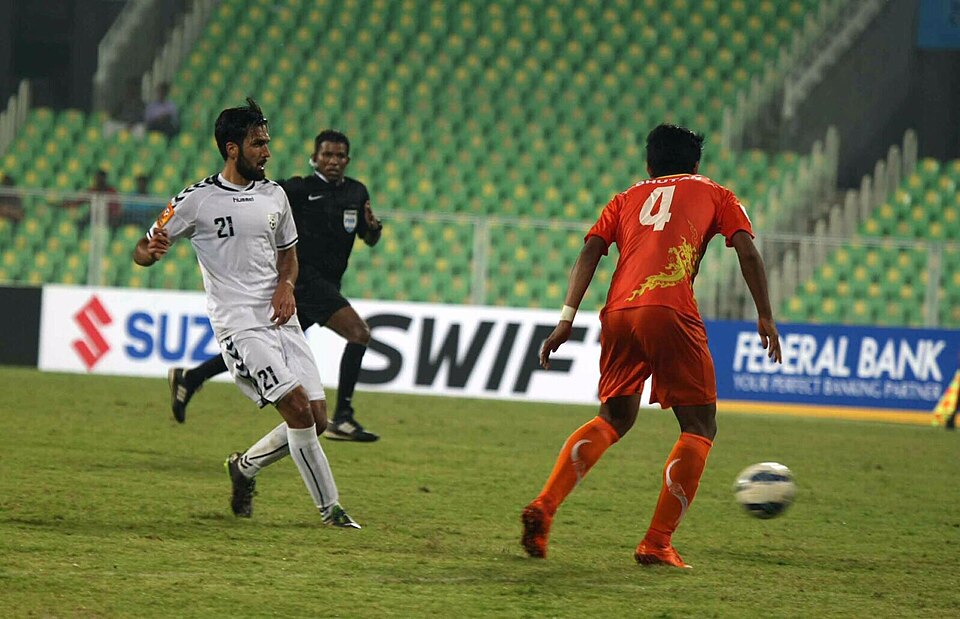

The style that got labelled tiki-taka is usually described as passing the ball around a lot. That describes the symptom. Underneath it sits a fairly strict spatial discipline about where players stand relative to each other and to opponents, and the passing follows from the positioning rather than the other way round.
Understanding the geometry makes the sport easier to watch and easier to play, and it is the same logic that decides whether a chain of passes survives or dies on the touchline.
Why the triangle is the basic unit
A player receiving the ball with only one available team-mate can be shut down by a single defender cutting that line. A player with two available team-mates at different angles cannot, because covering one lane opens the other. The triangle is the minimum structure that keeps the ball alive under pressure.
Positional systems arrange the pitch so triangles exist continuously, everywhere. As the ball moves the triangle reforms around its new position, and the player who just passed becomes the third point of the next one. That is why possession teams look like they are rotating constantly. They are maintaining a structure, not performing.
Spacing: too close is as bad as too far
Team-mates standing too close together let one defender cover both, which collapses the triangle into a line. Standing too far apart makes the pass slow enough to intercept and gives the defence time to shift across. The useful distance is the range at which a firm pass arrives before the covering defender does, and that distance shrinks as you approach the opposition goal and defenders get denser.
This is also what makes width matter so much. Players held wide on the touchline stretch the defensive block sideways, and every metre it stretches opens the interior lanes where the damaging passes get played.
The third-man run
The most productive pattern in possession football rarely involves the passer finding the player he is looking at. Player A passes to B, whose job is to pull a defender toward him and lay the ball off immediately to C, who is arriving into the space that defender has just left. C is the third man, and he receives facing forward with the defensive line broken.
It works because defending is reactive. The moment a defender commits to the receiver, the ground he was standing on becomes available, and the pass that exploits it has to already be moving. That is the difference between passing sideways and passing to progress.
Occupying opponents without touching the ball
In positional systems players are given zones rather than freedom, and a good part of the job is standing somewhere that forces an opponent to stand somewhere too. A winger who hugs the touchline pins the full-back even if the ball never comes near him, and that pin creates the channel a midfielder runs into.
So the most important player in a passing sequence is often the one who never receives it. When a move breaks down, the cause is frequently that somebody drifted out of the position that was holding a defender in place.
Passing lanes are a finite resource
Every pass uses up space and changes what is available next. Playing into a congested area can be legal and safe in the moment while killing the options you needed two passes later. The ball ends up in a corner with no clean exit, and possession is lost without any defender doing anything special.
Good passers get round this by choosing the pass that preserves the most future options rather than the one that gains the most ground. Working backwards from where the move is supposed to finish, and checking the route stays open, beats following the most obvious option each time.
Where it came from
The line runs from the Total Football of Ajax and the Netherlands in the 1970s, through Johan Cruyff's spell as Barcelona manager, to the Barcelona side under Pep Guardiola that won the Champions League in 2009 and 2011. Each version tightened the spatial rules rather than inventing new ones.
Modern descendants have added directness and counter-pressing, winning the ball back the instant it is lost, which only works because a well-spaced structure leaves players close enough to swarm it. Even in teams that look nothing like that Barcelona side, the same geometry is doing the work.
Key takeaways
- Triangles guarantee a second passing option, which is what makes possession sustainable under pressure.
- Spacing must be close enough for a fast pass and wide enough to stretch the defensive block.
- The third-man run exploits the space a defender vacates when he commits to the receiver.
- Choose the pass that preserves future options, not the one that gains the most ground now.
More football guides
- How football transfer fees actually work
- What makes a footballer expensive
- How to identify a football stadium from a single view
- Ten football stadiums worth knowing on sight
- A working timeline of modern football
- Six rule changes that reshaped football
- How to get better at football quizzes
- How top-ten lists work in football
- Why some passing moves have exactly one solution
- What makes a good football trivia question