The golden goal, the silver goal and the rule that ended both
By Marco Pereira · Nov 7, 2026
For about a decade a football match could end the moment someone scored in extra time. Here is who used the golden goal, why UEFA swapped it for something else, and the day the rule book dropped it.
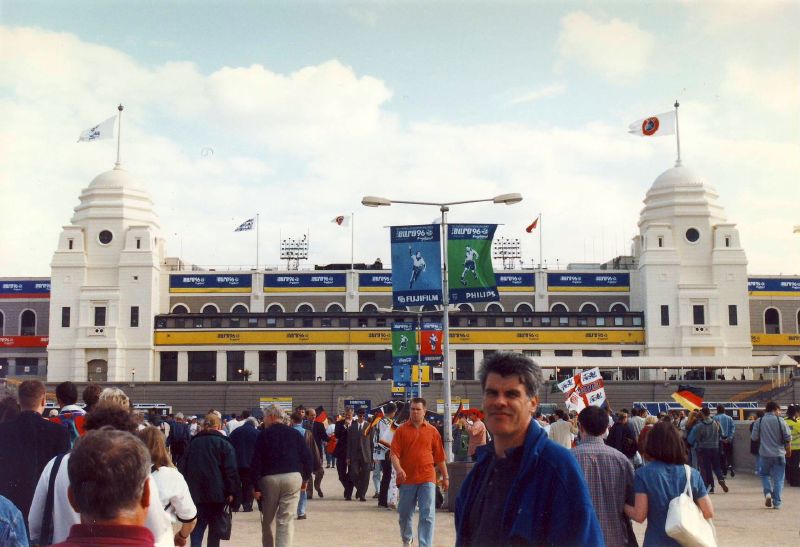

Picture a European final that is level after 90 minutes. Extra time starts, and in the fifth minute one team scores. The referee blows the whistle and the match is over, with most of the 30 minutes of extra time unplayed. That is how Germany won Euro 96, and the rule behind it was called the golden goal.
The rule did not last long, and nobody wrote down one clear reason for scrapping it. What the record does show runs from the first golden goal in 1994 to a Saturday meeting in London in February 2004.
What the rule said
The wording in the Laws of the Game is short. In the July 2003 edition, the procedure is called The Golden Goal. During the extra time played at the end of normal playing time, the team that scores the first goal is declared the winner. If no goal is scored, the match is decided by kicks from the penalty mark.
Two features matter. The match ended on the goal itself, with no time left for a reply. And it only applied where a competition's own rules asked for a winner, which is why a league game was never affected. Knockout football was where it lived.
The goals that ended matches
UEFA's own history of the rule names the first one: a golden goal decided the 1994 UEFA European Under-21 Championship final in Montpellier. Italy beat Portugal 1-0, and the scorer was Pierluigi Orlandini, a substitute who had come on in the 84th minute. UEFA's two pages on that match give different calendar days in April 1994, so this guide leaves the day out and keeps the month and year.
Senior tournaments followed. At Euro 96 at Wembley, Oliver Bierhoff's shot crept in off the post in the fifth minute of extra time, and Germany beat the Czech Republic 2-1. Four years later, David Trezeguet scored in extra time and France beat Italy 2-1 in the Euro 2000 final in the Netherlands.
Club football got its turn too. UEFA's page notes that no UEFA club competition had been settled by a golden goal until the 2001 UEFA Cup final, with one exception it names: Galatasaray's 2-1 win over Real Madrid in the 2000 UEFA Super Cup. In Dortmund, Liverpool and Deportivo Alavés were level at 4-4 after 90 minutes. In extra time, Alavés defender Delfi Geli headed a Gary McAllister free-kick into his own net, and Liverpool were the winners. UEFA called it the first golden goal to decide a UEFA club final and the first golden own goal.
- Source: UEFA.com: The golden goal (14 May 2002)
- Source: UEFA.com: Italy v Portugal background (U21 EURO match preview)
The first change: the silver goal
In May 2002, UEFA announced on its website that the UEFA Champions League final of that season would be the last where the golden goal applied in its current form. From 2002/03, the format changed: if a goal was scored in the first period of extra time, play carried on until the 15 minutes were complete. If the other team did not equalise, the scorer won. If the score was level, the second 15 minutes were played in full.
A year later, UEFA described the same system as the silver goal, the successor to the old golden goal. A team leading at the end of the first 15 minutes of extra time was declared the winner. Otherwise a second 15 minutes followed, and then a penalty shoot-out. UEFA's page on the change had a plain sentence on where the idea came from: it was the result of consultations with the football community, including many leading coaches.
- Source: UEFA.com: The golden goal (14 May 2002)
- Source: UEFA.com: The silver goal (28 April 2003, updated 19 May 2003)
Why UEFA moved on
UEFA's page gives three reasons, and it is careful about whose they are. The coaches it consulted said the golden goal put far too much pressure on the match referee, and did not give the team that conceded a chance to recover. UEFA itself was also concerned that the system encouraged negative football, with teams too worried about conceding to risk attacking play. A third concern was that a sudden end to a match could create safety and security problems.
The communications and public affairs director at the time, Mike Lee, said the new system would encourage positive football in extra time and produce a sensible and fairer ending to a game. That is a statement of intent rather than a result. The page was written before the silver goal had been used in a final, so it cannot tell us whether teams actually played more openly.
The day the rule book dropped it
The Laws of the Game belong to the International Football Association Board, known as IFAB. At its annual general meeting at Claridge's in London on 28 February 2004, it voted on a proposal from FIFA about Law 10, and the minutes record the result. The proposal had said that only certain procedures, approved by IFAB, could be used by competitions to decide a winner, and its list included the Golden Goal. The board adopted it with one change: the Golden Goal was removed from the list.
The minutes give the reason for the proposal as a confirmation of a decision from the board's September 2003 business meeting, that competition rules may only use procedures it approves. They do not give a reason for striking the golden goal out of that list. This guide therefore makes no claim about why, and notes only that the timing matches UEFA's move away from the rule.
The result shows in the next edition. The Laws of the Game dated July 2004 allow three procedures where a winner is required: the away goals rule, extra time, and kicks from the penalty mark. Extra time is described as two further equal periods, not exceeding 15 minutes each. The golden goal no longer appears.
- Source: IFAB: Minutes of the 2004 Annual General Meeting, 28 February 2004
- Source: IFAB: Laws of the Game, July 2004
Who decides: the Laws or the competition
It helps to know who owns which part. The Laws of the Game say how football is played. A competition's own rules say whether a drawn match needs a winner and how to find one. In the July 2003 Laws, the golden goal and kicks from the penalty mark are listed as methods a competition may choose when it requires a winning team after a draw.
That is why UEFA could change its own extra-time format for the Champions League in 2002/03 while the Laws still described the golden goal. The silver goal was a competition rule. Only when IFAB tightened the wording did the choice narrow. The Laws of the Game dated July 2004 carry a decision that only procedures approved by IFAB and contained in the publication are permitted in competition rules, and the list in that edition has no golden goal.
Both documents are public. IFAB publishes each edition of the Laws as a PDF, and the minutes of its general meetings sit on the same site. If you ever want to check when a rule changed, the edition that still has it and the edition that does not will give you the answer to within a year.
Putting it on a timeline
If you want to order these events from memory, the anchors are these. April 1994: the Under-21 final in Montpellier. 1996: Euro 96. 2000: Euro 2000 and the Super Cup. 2001: the UEFA Cup final. 2002/03: the silver goal in the Champions League. February 2004: IFAB votes to remove the golden goal.
The trap in this story is how short it was. The golden goal decided a UEFA club final in 2001, the silver goal replaced it for 2002/03, and by February 2004 the rule book had dropped the golden goal. Place those three steps in the wrong order and the whole story reads differently. TimeLineup asks you to make exactly that kind of call with real moments from the sport's past, and tells you after each attempt which ones are in the right slot.
- Source: UEFA.com: The golden goal (14 May 2002)
- Source: UEFA.com: The silver goal (28 April 2003, updated 19 May 2003)
- Source: IFAB: Minutes of the 2004 Annual General Meeting, 28 February 2004
Key takeaways
- Under the golden goal, the first goal in extra time ended the match; if there was none, kicks from the penalty mark decided it.
- UEFA places the first golden goal at the 1994 Under-21 final, and it decided Euro 96, Euro 2000 and the 2001 UEFA Cup final.
- From 2002/03 UEFA used the silver goal: play continues to the end of the first 15 minutes of extra time, and a lead at that point wins.
- UEFA cited referee pressure, no chance to recover, and negative football. IFAB's minutes record that it removed the golden goal on 28 February 2004 without giving a reason.
More football guides
- Football loans, options and obligations to buy
- How clubs get paid for training young players
- The Bosman ruling and transfer fees
- How football transfer fees actually work
- What makes a footballer expensive
- How to identify a football stadium from a single view
- Ten football stadiums worth knowing on sight
- A working timeline of modern football
- Six rule changes that reshaped football
- Passing triangles and the logic of positional play
- How to get better at football quizzes
- How top-ten lists work in football
- Why some passing moves have exactly one solution
- What makes a good football trivia question